Guide · Consensus
Proof of work vs proof of stake: which should your coin use?
Proof of work and proof of stake are two ways a blockchain agrees on the next block. Proof of work uses computing power, proof of stake uses coins locked up as a deposit. Both work. The right one for a new coin depends mostly on how big and how open your network will be, and this guide shows how to decide.

By Sara, Bitcoin writer
Updated · 7 min read
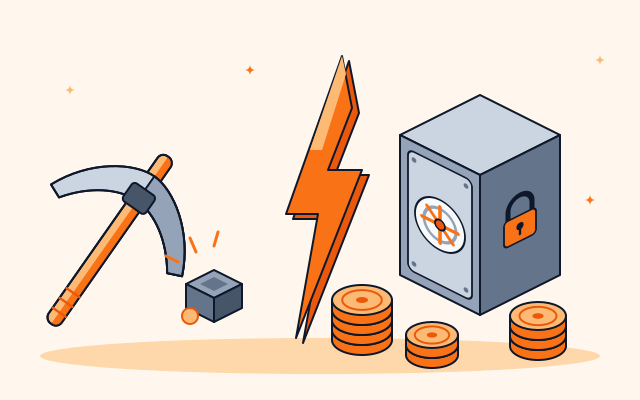
Before we start
Which one sounds like you?
What's inside
5 chapters. Read it start to finish, or jump to the part you need.
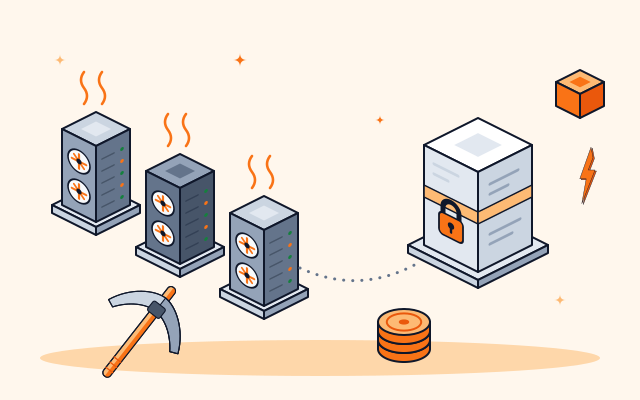 Chapter 1How proof of work worksMiners race to solve a puzzle. Security comes from cost, which is great for Bitcoin and risky for a tiny coin.
 Chapter 2How proof of stake worksValidators lock up coins as a deposit and lose them if they cheat. Far less energy, and harder to attack cheaply.
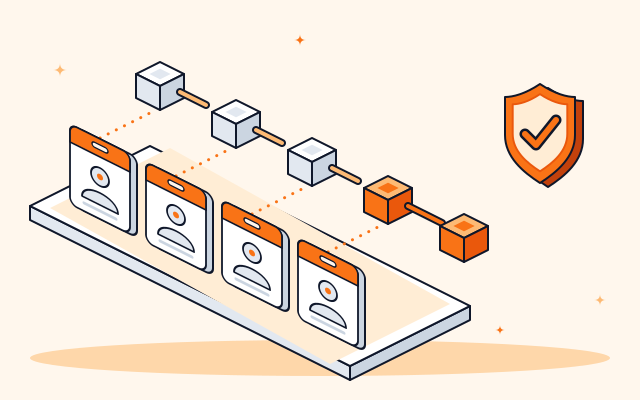 Chapter 3A third option: proof of authorityA fixed list of known validators. Fast and predictable, ideal for private and business chains.
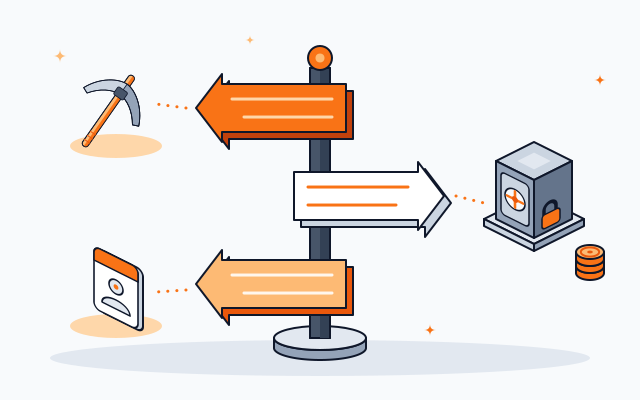 Chapter 4Which should your coin use?Two questions decide it: will strangers secure the network, and how much mining power or stake can you attract at the start?
 Chapter 5Setting it up in the RocketRPC builderEvery option above is a choice in the builder, with recommended settings for each.
The short answer
The short answer
Proof of work (PoW) secures a blockchain with mining: computers race to solve a puzzle, and rewriting history would cost as much computing power as the network has spent. Proof of stake (PoS) secures it with deposits: validators lock up coins and lose them if they cheat. PoW is open to anyone with hardware; PoS uses far less energy and is harder to attack cheaply when your network is small.
| Proof of work | Proof of stake | |
|---|---|---|
| Who adds blocks | Miners with computing power | Validators who lock up coins |
| What stops cheating | Cheating costs electricity and hardware | Cheaters lose their locked coins (slashing) |
| Energy use | High, by design | Low: Ethereum cut its energy use by about 99.95 percent when it switched |
| Who can join | Anyone with mining hardware | Anyone who holds and locks enough coins |
| Risk for a small new coin | Miners can be rented to attack a coin with little mining power | An attacker must first buy a large share of the coins |
| Well-known examples | Bitcoin, Litecoin, Dogecoin | Ethereum (since 2022), Cosmos chains |
That is the headline. The real question is which one is safe for a coin that is just starting out, and that is where most explainers stop.
1Chapter 1
How proof of work works
Miners race to solve a puzzle. Security comes from cost, which is great for Bitcoin and risky for a tiny coin.
In proof of work, miners repeatedly hash the next block with a different number until the result falls below a target. The first miner to find one adds the block and earns the block reward. Other nodes check the answer instantly, which is what makes the system trustless.
2,016
Security comes from cost. To change a past block, an attacker would have to redo that block's work and all the work after it, faster than the honest network. Bitcoin's developer guide notes that this takes about a majority of the network's hashing power, which is where the name “51%” attack comes from.
2Chapter 2
How proof of stake works
Validators lock up coins as a deposit and lose them if they cheat. Far less energy, and harder to attack cheaply.
In proof of stake, validators lock up coins as a deposit. The protocol picks validators to propose and confirm blocks, roughly in proportion to their stake. Ethereum is the biggest example, and its numbers show how it fits together:
- Deposit32 ETHWhat one Ethereum validator locks up.
- Slot12 secondsOne chance to propose a block.
- Epoch32 slotsA group of slots, about 6.4 minutes.
Honest validators earn rewards. Validators who break the rules, for example by signing two different blocks for the same slot, are slashed: part or all of their stake is destroyed. Once Ethereum finalises a block, reverting it would mean burning at least a third of all staked ETH.
99.95%
3Chapter 3
A third option: proof of authority
A fixed list of known validators. Fast and predictable, ideal for private and business chains.
Proof of authority (PoA) uses a fixed list of known validators, usually the company or partners running the chain. It is fast, cheap and predictable, but it is not open: users trust the validator list instead of mining power or stake.
- Good forLoyalty points, internal settlement, game economies run by one studio, test networks.
- Not forA public coin where strangers should be able to help secure the network.
Ethereum-based chains in our builder default to proof of authority for this reason: most people building an app chain want speed and control first.
4Chapter 4
Which should your coin use?
Two questions decide it: will strangers secure the network, and how much mining power or stake can you attract at the start?
Ask yourself two questions: will strangers secure the network, and how much mining power or stake can you realistically attract at the start?
| Your situation | Good fit | Why |
|---|---|---|
| A community that wants to mine | Proof of work | Anyone can join with hardware, and mining spreads coins fairly at launch |
| An open coin with a small early community | Proof of stake | Attacking it means buying a large share of the coins first |
| A chain for apps, tokens and swaps | Proof of stake or proof of authority | Ethereum and Cosmos bases run smart contracts on either |
| A private or business ledger | Proof of authority | Known validators, fast blocks, no mining or staking to manage |
| Holders who want to earn by locking coins | Masternodes (Dash or PIVX style) | Holders run special nodes and share the rewards |
5Chapter 5
Setting it up in the RocketRPC builder
Every option above is a choice in the builder, with recommended settings for each.
- Proof of work: start from Bitcoin, Litecoin, Dogecoin or Bitcoin Cash. Add a mining pool so miners can join.
- Proof of stake: start from Cosmos, or choose proof of stake for an Ethereum-based chain.
- Proof of authority: choose an Ethereum or BNB Chain base. You run the validators.
- Masternodes: start from Dash or PIVX.
Each base comes with recommended settings and the minimum number of nodes it needs to stay online. A coin with its own blockchain starts at $149 one-time, with hosting at $5 per server per month after launch.
Questions people ask
Is proof of stake more secure than proof of work?
For a large network, both are secure. For a small new coin, proof of stake is usually harder to attack cheaply, because an attacker must buy a large share of the coins rather than rent mining power.
Why does proof of work use so much energy?
Because the security comes from the cost of computing. Miners spend electricity racing to solve each block, and that spending is what makes rewriting history expensive.
Can a coin switch from proof of work to proof of stake?
Yes, but it is a major upgrade that every node must adopt. Ethereum did it in 2022 after years of preparation. For a new coin, it is far easier to choose the right one at launch.
What is slashing?
A penalty in proof of stake. A validator that breaks the rules, for example by signing two conflicting blocks, loses part or all of its locked stake.
What is a 51 percent attack?
An attack where someone controls most of the mining power (in proof of work) and uses it to rewrite recent blocks, for example to spend the same coins twice.
Which consensus is best for a private blockchain?
Usually proof of authority. The validators are known in advance, so you get fast, predictable blocks without mining or staking.
Read next
 How to create a cryptocurrencyThe full guide: base, rules, supply calculator, nodes, wallets and costs.
 Coin vs tokenDo you need your own blockchain at all?
- Create a blockchain with RocketRPCWhat you get, what it costs and how the launch works.
 GlossarySlashing, halving, genesis block and more, in one line each.
Sources
- Bitcoin developer guide, block chain, proof of work, the 2,016-block difficulty adjustment and the majority hash power attack
- ethereum.org, proof of stake, 32 ETH deposit, slots and epochs, slashing, finality
- ethereum.org, The Merge, 15 September 2022 and the energy reduction
- BleepingComputer, Bitcoin Gold double-spend attack (May 2018)