Guide · Meme coins
How to create a meme coin that does not disappear in a week
Anyone can make a meme coin in an afternoon. That is exactly why most of them die. CoinGecko found that 11.6 million tokens on decentralised exchanges failed in 2025 alone. This guide shows how a meme coin gets made, what kills it, how to launch honestly, and the other way to do it: a meme coin with its own blockchain, like Dogecoin.
By Isac, Memecoin writer
Updated · 13 min read

Before we start
Which one sounds like you?
What's inside
6 chapters. Read it start to finish, or jump to the part you need.
- Chapter 1What a meme coin is, and what the law saysA coin built on a joke, a character or a trend. The SEC calls them collectibles; the law still has teeth.
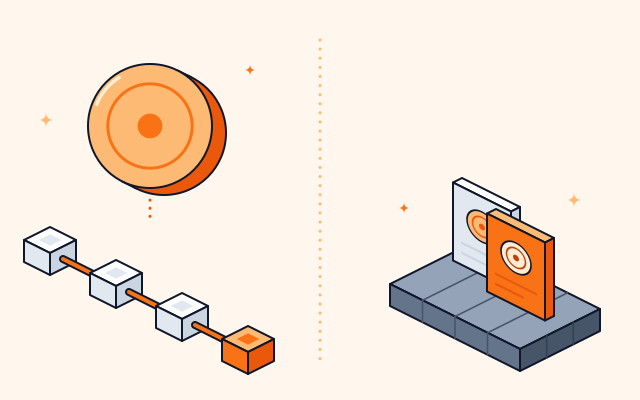 Chapter 2The token route, step by stepWhat making a token on Solana, Ethereum or BNB Smart Chain actually involves, with the official documentation for each.
 Chapter 3Liquidity, in plain wordsA token that exists is not a token that trades. Liquidity is the missing piece, and the one most rug pulls hide behind.
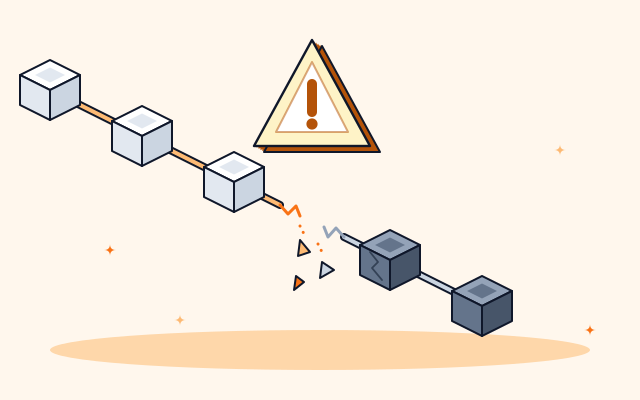 Chapter 4What kills meme coins, and how holders spot a rug pullMore than half of tracked DEX tokens have failed. Here is how they die, and the red flags buyers check.
 Chapter 5Community first, then the coinThe coins that last had people before they had a price. What to do before, on and after launch day.
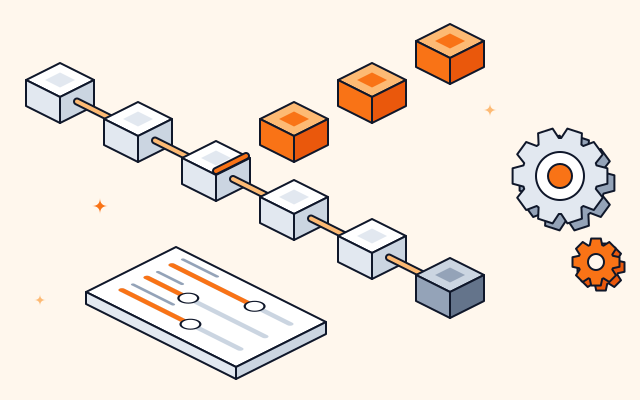 Chapter 6The other route: a meme coin with its own blockchainDogecoin is a meme coin on its own chain. You can start from the same family and keep control of the rules.
The short answer
The short answer
To create a meme coin, pick a theme people already laugh about, then choose a route. The quick route is a token on Solana, Ethereum or BNB Smart Chain, made with that chain's token standard, plus a liquidity pool so people can trade it. The other route is a coin with its own blockchain, like Dogecoin. Either way, the coin only lasts if a real community wants it.
- Step 1: Start with the joke and the peopleA theme your community already shares beats any clever name.
- Step 2: Choose your routeA token on someone else's chain, or a coin on its own blockchain.
- Step 3: Decide the supply in publicTotal coins, who gets how many, and what you can never change.
- Step 4: Create itUse the chain's official token standard, or start from a coin such as Dogecoin.
- Step 5: Make trading possibleA liquidity pool for a token; an explorer, wallets and nodes for a coin.
- Step 6: Keep showing upAnswer questions, publish facts, never promise a price.
Making the coin is the easy part. Here is why that is a problem, and what to do about it.
1Chapter 1
What a meme coin is, and what the law says
A coin built on a joke, a character or a trend. The SEC calls them collectibles; the law still has teeth.
A meme coin is a crypto asset inspired by an internet joke, a character or a trend, usually with a community that buys and trades it for fun. The US Securities and Exchange Commission describes them this way in a staff statement on meme coins: bought for entertainment or social reasons, valued mainly by demand and speculation, and usually with little or no practical use.
- Route 1 · fastestA tokenA balance inside a smart contract on Solana, Ethereum or BNB Smart Chain. Cheap to make, easy to abandon. Chapters 2 to 5 cover it.
- Route 2 · what Dogecoin isA coin on its own blockchainYour own network, supply rules and miners. More to run, but nobody else controls the rules. Chapter 6 covers it.
2Chapter 2
The token route, step by step
What making a token on Solana, Ethereum or BNB Smart Chain actually involves, with the official documentation for each.
A token is not its own blockchain. It is a record kept by a program on a chain that already exists. Each chain has an official way to make one:
| Chain | How the token is defined | Read the official docs |
|---|---|---|
| Solana | A mint account stores the token's details, and Solana's token programs hold the rules for it | Solana documentation, tokens |
| Ethereum | A smart contract that follows a standard for fungible tokens, proposed in November 2015 | ethereum.org, the ERC-20 standard |
| BNB Smart Chain | A smart contract that follows an interface standard derived from ERC-20 | BNB Chain, the BEP-20 proposal |
- Step 1: Pick the chainWhere your community already has wallets and uses apps.
- Step 2: Set up a walletAnd write the recovery phrase on paper. Anyone who has it owns your coins.
- Step 3: Practise on a test networkMake a throwaway token first. Mistakes on the real network are permanent.
- Step 4: Create the tokenName, ticker, total supply and the decimals that set how small a coin can be split.
- Step 5: Put the supply where you can show itPublish which wallets hold what.
- Step 6: Decide what you give upSee the callout below. This one decision is what holders check first.
3Chapter 3
Liquidity, in plain words
A token that exists is not a token that trades. Liquidity is the missing piece, and the one most rug pulls hide behind.
Creating a token gives you a balance. It does not give anyone a way to buy it. On a decentralised exchange (DEX), trading works through a liquidity pool: a stash of two tokens, for example your meme coin and a main coin, held by a smart contract. Ethereum's DeFi overview puts the appeal simply: on a DEX, "you never give up control of your assets".
- The poolTwo tokens in one placeSomeone deposits both. That deposit is the liquidity.
- The priceSet by the ratioThe price comes from how much of each token is in the pool, not from a person.
- The receiptA liquidity tokenWhoever deposits gets a token proving their share, and can burn it later to take their coins back.
Two things follow from this, and both matter to anyone who buys your coin:
- A small pool moves a lot. Ethereum's walk-through of a pool contract notes that large pools are better than small ones, because they have more stable prices. A tiny pool means one purchase swings the price.
- The receipt is the key to the pool. If the person who made the pool still holds the liquidity token, they can take the liquidity out whenever they like, and holders are left with a coin nobody can buy or sell. That is how most rug pulls work.
So the honest thing to do with that receipt is to lock it, for a long time, and show everyone.
4Chapter 4
What kills meme coins, and how holders spot a rug pull
More than half of tracked DEX tokens have failed. Here is how they die, and the red flags buyers check.
53.2%
That research counts tokens on decentralised exchanges, which is where tokens made the quick way end up trading. Here are the ways a meme coin typically dies:
- No reason to come backA joke gets a day of attention. Without people talking and building, it ends with the day.
- Founders disappearNo updates, no answers. Holders assume the worst, and sell.
- A pool too thin to tradeOne sale crashes the price, so nobody dares to buy.
- A rug pullThe creators take the money out of the pool or sell their huge holding, then vanish.
- Supply nobody can explainWallets that hold most of the supply scare buyers away.
- Promises of profitThey attract the wrong crowd, and the wrong regulators.
The red flags holders check
| Red flag | Why it matters | Where to look |
|---|---|---|
| Liquidity not locked | The pool's owner can take it all out | The pool page or the chain's block explorer |
| Mint authority still set (Solana) | The creator can make unlimited new coins | The token's mint account on a Solana explorer |
| Contract can create more or block selling | Same risk on Ethereum and BNB chains | The verified contract code on the chain's explorer |
| A few wallets hold most of the supply | One sale can empty the pool | The holders list on the explorer |
| Anonymous team, no updates | Nobody to answer for the coin | The project's website and chat |
| Promises of returns | No honest project can promise them | The project's own posts |
If you are the creator, treat this table as your launch to-do list. Every item you fix is one fewer reason for a stranger to walk away. The checklist below puts it all in one place.
5Chapter 5
Community first, then the coin
The coins that last had people before they had a price. What to do before, on and after launch day.
A meme coin is a shared joke with a ledger attached. Without the joke and the people, the ledger is just a number. Value, if it comes, comes from people who want to hold or use the coin, and nobody can promise that.
- BeforeFind the peopleBuild the chat and the jokes first. Ten people who care beat ten thousand who clicked.
- BeforeWrite the rules downTotal supply, who holds what, what you can and cannot change, and what the coin is for. Plain words, one page.
- LaunchLock and showLock the liquidity, give up the powers you do not need, and publish the wallet addresses.
- AfterKeep answeringReply in the chat, post what you do next, and say "I do not know" when you do not.
Your honest meme coin launch checklist
0 of 8 done
6Chapter 6
The other route: a meme coin with its own blockchain
Dogecoin is a meme coin on its own chain. You can start from the same family and keep control of the rules.
Dogecoin is the original meme coin, and it is not a token. It has its own blockchain, its own miners and its own rules. It launched on 6 December 2013, and its protocol was based on Litecoin, which came from Bitcoin. You can copy the same family today.
| Token on another chain | Coin on its own blockchain | |
|---|---|---|
| Who sets the rules | The chain it lives on | You |
| How new coins appear | Fixed when the token is made | Block rewards to miners, by your rules |
| What trading needs | A liquidity pool | An exchange or a swap that lists it |
| What you must run | Nothing, the chain runs it | Nodes, an explorer and wallets |
| Fees | Paid in the host chain's coin | Set by your own chain |
The rules of the real thing are a good template. In the Dogecoin Core source code, the block time target is one minute, and the reward is a constant 10,000 coins per block from block 600,000 on, with no cap. That means a new supply arrives forever at a steady rate, which suits a coin meant for tipping and spending.
- 3 January 2009BitcoinThe first block. All the code below descends from it.
- 7 October 2011LitecoinOpen-source code derived from Bitcoin, with faster blocks.
- 6 December 2013DogecoinBased on Litecoin's lineage, meant as a joke, kept alive by people.
With RocketRPC you can start from Dogecoin's rules and change what you want: the name, the supply, the block time and the genesis block. Your own coin with its own blockchain starts at $149 one-time, with hosting at $5 per server per month after launch, and it deploys in about 30 minutes once payment is confirmed. Add an explorer and wallets so people can use it, and a mining pool if you want a community of miners.
Questions people ask
How do I create a meme coin?
Pick a theme and a community, then choose a route. The quick route is a token on Solana, Ethereum or BNB Smart Chain using that chain's official token standard. The other is a coin with its own blockchain, like Dogecoin. Either way, plan the supply and the community before you launch.
Can I create a meme coin for free?
A token costs little more than the network fee for creating it, and that fee changes by chain and by day. Trading needs a liquidity pool, which means putting real money in. A coin with its own blockchain has a hosting cost, because its nodes run on servers around the clock.
Do I need to know how to code to make a meme coin?
No for the basics, but you must understand what you are creating. Know the total supply, who holds it and which powers you keep, such as minting or freezing. A coin with its own blockchain through our builder needs no coding either: every setting has a recommended default.
Is it legal to create a meme coin?
Creating one is legal in most places. What brings rules into play is how you sell and promote it. In February 2025 SEC staff said the meme coins they described are generally not securities, but that is a staff view, not a rule, and fraud is still pursued. In the EU, public offers need a white paper unless they stay at or below EUR 1,000,000 over 12 months. This is not legal advice.
Do meme coins have any value?
Only what people give them. The SEC staff describe meme coins as bought for entertainment and valued mainly by demand and speculation. Nobody can promise a price, and you should be wary of anyone who does.
Which blockchain is best for a meme coin?
The one where your community already has wallets: Solana, Ethereum and BNB Smart Chain are the common token chains. If you want control over supply, fees and mining, a coin on its own blockchain is the alternative, as Dogecoin shows.
What is a rug pull?
A rug pull is when a token's creators take the money out and disappear. The most common way is withdrawing the liquidity from the trading pool, so holders cannot sell. Locked liquidity, no extra minting and a visible supply split make it much harder.
Can a meme coin have its own blockchain?
Yes. Dogecoin is one. It launched in December 2013 with its own chain, based on Litecoin. With RocketRPC you can start from the Dogecoin family, set your own rules and have it deployed in about 30 minutes after payment.
Read next
- How to create a cryptocurrencyThe complete guide, from coin or token to launch day.
 Tokenomics explainedSupply, rewards, premine and vesting, with real numbers.
 Create a blockchain with RocketRPCYour own coin on its own blockchain, with nodes and an explorer.
 Coin vs tokenThe difference, and when each one makes sense.
Sources
- CoinGecko research, how many cryptocurrencies failed, 53.2 percent of tokens on decentralised exchanges failed; 11.6 million in 2025; updated April 2026
- SEC, Staff Statement on Meme Coins, Division of Corporation Finance staff, 27 February 2025: definition, scope, not a rule, fraud still pursued
- Solana documentation, tokens, mint accounts, mint authority and freeze authority
- ethereum.org, ERC-20 token standard, proposed November 2015
- BNB Chain, BEP-20 proposal, interface standard derived from ERC-20
- ethereum.org, decentralized finance (DeFi), trading on a DEX without giving up control of assets
- ethereum.org, annotated pool contract walk-through, liquidity tokens, price from reserves, larger pools are more stable
- dogecoin.com, "first meant to be a joke"
- Dogecoin Core source, chainparams.cpp, one-minute block time target
- Dogecoin Core source, dogecoin.cpp, constant 10,000 coin reward after block 600,000
- Wikipedia, Dogecoin, launched 6 December 2013, based on Litecoin and Luckycoin
- Wikipedia, Litecoin, released 7 October 2011, derived from Bitcoin
- ESMA, MiCA Article 4 (public offers), white paper duty and the EUR 1,000,000 threshold