Guide · Tron
How to create your own Tron-based blockchain
Many people know Tron from USDT payments, and some ask how to run a network like it. You can: the java-tron software is open source and has an official guide for private networks. This guide explains what you get, what you can change and where the gaps are.

By Julie, Crypto payments writer
Updated · 8 min read
Before we start
Which one sounds like you?
What's inside
7 chapters. Read it start to finish, or jump to the part you need.
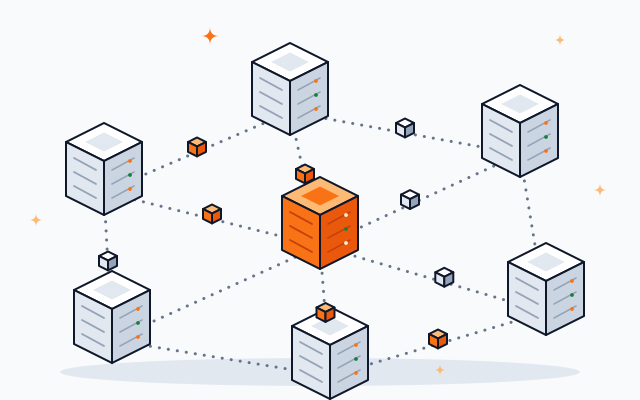
 Chapter 1What a Tron-based chain isYour own network, run by block producers you choose. Not a token on Tron.
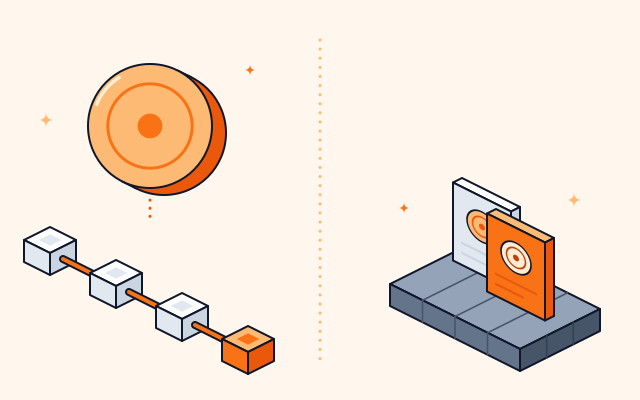
 Chapter 2The setup in plain EnglishTwo nodes are the minimum. One makes blocks, one follows.
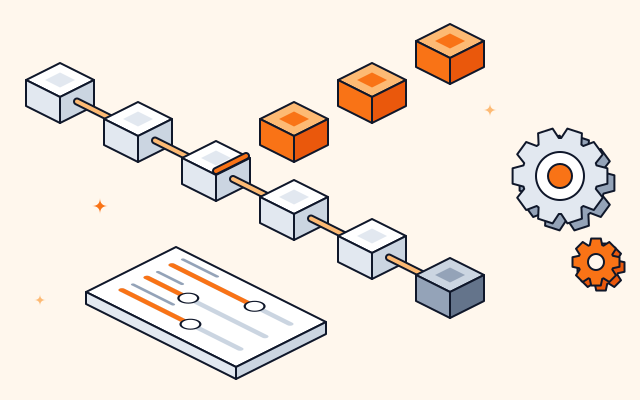
 Chapter 3What you can customiseNetwork number, block producers, starting balances and proposal timing. The coin name is not a setting.
 Chapter 4Tokens, wallets and explorers: the limitsTRC-20 tokens are available. A full explorer and confirmed wallet support are not.
- Chapter 5Servers and licenceMainnet specs are large. A private network is smaller, but no official number exists.
 Chapter 6Common mistakesSetup errors from the official steps, and one planning error.
 Chapter 7What it costs with RocketRPCA one-time core price. We start at the minimum of 2 servers.
The short answer
The short answer
To create a Tron-based blockchain, you run the open-source java-tron software as a private network. The official guide needs one block-producing node (called a Super Representative node) and at least one regular full node. You set a network number, the block producers and the starting balances in config files, and your network stays separate from Tron mainnet.
- Step 1: Install Java and java-tronUse the same release for the program and its config.
- Step 2: Make two node foldersOne block producer, one full node.
- Step 3: Edit the configsNetwork number, producers, starting balances, seed node.
- Step 4: Start the producer, then the full nodeThe full node syncs from the producer.
- Step 5: Set the chain parametersDone with two proposals.
- Step 6: Add a wallet and faucetSo people can use it.
The setup is short. The surprises come later, with explorers and wallets.
1Chapter 1
What a Tron-based chain is
Your own network, run by block producers you choose. Not a token on Tron.
java-tron is the main software behind Tron. Its repository describes it as a scalable blockchain OS with delegated proof of stake. In that model, a small group of block producers, called Super Representatives, make the blocks. The repository is under the LGPL-3.0 license.
- This guideA private Tron networkYour own network, block producers and starting balances. It does not connect to Tron mainnet.
- Not this guideA token on TronA TRC-20 token made on the live Tron network. It is fast, but you cannot change the network.
Your network and Tron mainnet stay apart because of a network number you choose. If you only need a token, read coin or token before you build a chain.
A delegated model has a practical effect for a small team. You pick the block producers yourself, so you decide who is trusted. That makes it simpler than mining, which needs outside miners, and it suits a payments or business network where the operators are known.
2Chapter 2
The setup in plain English
Two nodes are the minimum. One makes blocks, one follows.
The official private chain guide says that a minimal private chain has one block-producing node plus at least one regular full node. Here is the flow it describes:
- PrepareSoftwareOracle JDK 8 on x86_64 or JDK 17 on ARM64, plus Node.js 18 or later for the proposal script.
- FoldersOne per nodeCopy the FullNode program and its config.conf into a producer folder and a full node folder.
- ConfigureEdit both configsThe producer holds its own key. The full node points to the producer as its only seed.
- StartProducer firstStart the producer with the witness flag, then start the full node.
- TuneTwo proposalsSet the chain parameters through proposals approved on chain.
The last step, the proposals, is how a private network gets its chain parameters set. The guide runs a script that creates a proposal, waits for it to be on chain, approves it with the block producer, and then checks the result with the wallet/getchainparameters call. It does this twice. The docs warn that parameter IDs vary by java-tron version, so query your own network before you propose anything. One of the proposals needs java-tron 4.8.1 or later.
Match the config to the program: the docs say config.conf must come from the same version as your FullNode.jar.
3Chapter 3
What you can customise
Network number, block producers, starting balances and proposal timing. The coin name is not a setting.
| Setting | What it does |
|---|---|
| genesis.block.witnesses | The addresses of your block producers |
| genesis.block.assets | Accounts that start with a TRX balance, your premine |
| node.p2p.version | Your network number. It must be a positive number, not 11111, 1 or 201910292. |
| seed.node.ip.list | Where nodes find each other. Remove the public seeds. |
| block.proposalExpireTime | 10 minutes on the private chain |
| block.maintenanceTimeInterval | 5 minutes on the private chain |
genesis.block.witnesses
- What it does
- The addresses of your block producers
genesis.block.assets
- What it does
- Accounts that start with a TRX balance, your premine
node.p2p.version
- What it does
- Your network number. It must be a positive number, not 11111, 1 or 201910292.
seed.node.ip.list
- What it does
- Where nodes find each other. Remove the public seeds.
block.proposalExpireTime
- What it does
- 10 minutes on the private chain
block.maintenanceTimeInterval
- What it does
- 5 minutes on the private chain
The starting balances are worth a careful look. Whatever you put under genesis.block.assets is your premine, and it must be identical on every node. Decide the owners and amounts before you start.
Fees and other parameters are adjusted by proposals, which block producers approve. The docs show the steps to create a proposal and check the result. A coin name or symbol is not a first-class setting here, so your coin is called TRX in tools unless you build a token on top.
4Chapter 4
Tokens, wallets and explorers: the limits
TRC-20 tokens are available. A full explorer and confirmed wallet support are not.
The Tron docs describe TRC-20 as "a set of contract standards for issuing fungible token assets on TRON". If your community wants several tokens on your network, TRC-20 is the way to build them.
- LimitExplorerThe Tronscan front end is open source (LGPL-3.0), but by default it connects to the public Tronscan API. We found no published backend for it, so we do not offer an explorer on Tron.
- UnconfirmedWalletsWe could not confirm that TronLink supports a custom network. Test before you promise it to users.
- We offerWeb wallet and faucetOur own web wallet and a faucet, so users can hold coins and get free starter amounts.
For a payments project, this shapes the plan. Your users will need a way to hold coins and to check that a payment arrived. Our web wallet covers holding. For checking, plan to share transaction details from your own tools, or consider whether a chain from another family, which comes with a ready explorer, fits better.
5Chapter 5
Servers and licence
Mainnet specs are large. A private network is smaller, but no official number exists.
64 GB+
The java-tron README lists mainnet needs: a full node of at least 8 cores, 16 GB of RAM and 200 GB (Lite), and a Super Representative of 32 or more cores, 64 GB or more of RAM and 4 TB of storage. It also says test networks can run on lower specifications because their transaction volume is much smaller.
It gives no figure for a private chain. The official launch commands allow Java 6 GB of memory, so each node needs a machine with comfortably more RAM than that. We size servers with room to spare.
6Chapter 6
Common mistakes
Setup errors from the official steps, and one planning error.
- Mixing releasesThe config must come from the same version as the program.
- Leaving public seed nodes inRemove them, so your nodes only find each other.
- Reusing a network numberDo not use 11111, 1 or 201910292. Those belong to other Tron networks.
- Different genesis on each nodeThe producers and starting balances must match on every node.
- One block producer onlyIf it stops, the chain stops.
Before you launch a Tron-based chain
0 of 5 done
7Chapter 7
What it costs with RocketRPC
A one-time core price. We start at the minimum of 2 servers.
The builder prices a Tron network in the Advanced tier: $199 one-time. It starts at 2 servers, which matches the official minimum of one block producer and one full node. Wallet and faucet add-ons show their own prices before you pay.
One block producer means one point of failure. If you need your chain to keep running when a producer stops, set more producers in the builder (up to 13: Tron allows 27, and the builder keeps at least one regular node).
A good way to start is the minimum: one block producer and one full node. Run it as a test with your team, send some coins between accounts, and check that both nodes stay in step. Then add more block producers before real users arrive.
There is no fee to any outside network. The ongoing cost is only the servers we run for you.
Questions people ask
Can I create my own Tron blockchain?
Yes. java-tron is open source and the TRON docs have an official guide for private networks. Your network is separate from Tron mainnet.
How many nodes do I need?
The official guide says a minimal private chain has one block-producing node and at least one regular full node. For more safety, use several block producers.
Is a Tron-based chain the same as a TRC-20 token?
No. A TRC-20 token lives on the live Tron network. A Tron-based chain is your own network with its own block producers and balances.
Can I change the block time?
The official private chain guide shows no block time setting, so we do not offer it.
Will my coin have its own name?
The coin is TRX in the tools. A name or symbol is not a setting in the official guide, so branding is cosmetic.
Can I get a block explorer for my Tron chain?
Not from us. The Tronscan front end is open source, but we found no published backend for it, so we do not offer a Tron explorer.
Does TronLink work with a private chain?
We could not confirm it. We offer our own web wallet instead.
What does it cost?
$199 one-time for the core build and $9 a month per server, starting at 2 servers. The builder shows the total.
Read next
Sources
- TRON developer docs, Tron private chain, steps, config keys and minimum nodes
- java-tron repository, LGPL-3.0, DPoS
- TRON developer docs, TRC-20
- Tronscan front end repository, LGPL-3.0, connects to the public API by default