Guide · Solana
How to create your own blockchain on Solana
Most guides with this title show you how to make a token. This one is about a real chain: your own Solana-based network with its own coin, its own validators and its own rules. It is the heaviest of the starting coins we offer, so this guide is honest about what works, what costs money and what is still uncertain.

By Abraham, Blockchain researcher
Updated · 9 min read
Before we start
Which one sounds like you?
What's inside
7 chapters. Read it start to finish, or jump to the part you need.
 Chapter 1What a Solana-based chain really isNot a token, and not Solana mainnet. A separate cluster that runs the same software.
 Chapter 2What you can customiseEpoch length, fees, inflation and the starting balances. The coin name is not on the list.
- Chapter 3Validators: why at least threeThe docs give no minimum. This is our advice, and the reasoning behind it.
 Chapter 4Hardware: the official specs are for mainnetThe numbers look huge. A new chain starts empty, but there is no official small-chain spec.
 Chapter 5Explorer, faucet and wallets: the honest pictureA faucet and explorer exist. Wallet support is the part to check before you promise anything.
 Chapter 6Mistakes that stop a first Solana chainFive things that trip people up, and the check for each.
 Chapter 7What it costs with RocketRPCA one-time core price, and a review before you pay.
The short answer
The short answer
To create your own blockchain on Solana, you run the open-source Agave validator software with a new genesis config. The genesis sets your coin supply, fees, epoch length and first validator. Because the genesis is different, your chain is independent from Solana mainnet. Plan on at least 3 validators, and expect heavy servers.
- Step 1: Decide: chain or tokenA token lives on Solana. A chain is a separate network.
- Step 2: Write the genesis configSupply, fees, epoch length, inflation.
- Step 3: Start the first validatorIt makes the first blocks.
- Step 4: Add more validatorsAt least 3 in total is our advice.
- Step 5: Add a faucet and explorerSo people can get coins and check the chain.
- Step 6: Check wallet supportThis is the weakest part today.
Three of those steps are harder than they look. Here is why.
1Chapter 1
What a Solana-based chain really is
Not a token, and not Solana mainnet. A separate cluster that runs the same software.
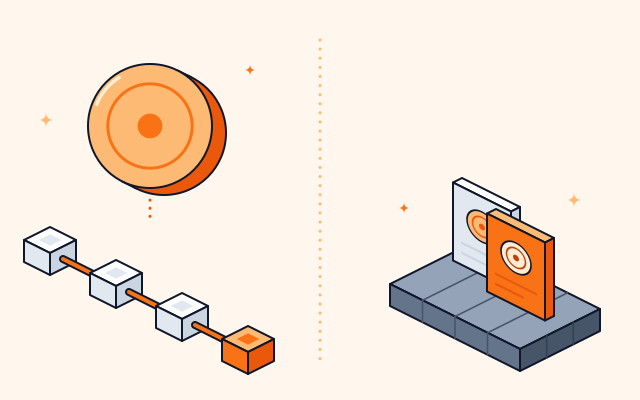
Solana calls a network a cluster. Mainnet is one cluster. Yours would be another, with the same software but a different starting point. The Anza docs explain that before any validators start, you create a genesis config. Clusters with different genesis configs simply ignore each other.
- This guideYour own clusterYour own coin, validators, fees and supply. It does not use SOL, and it is not connected to mainnet.
- Not this guideA token on SolanaA token made on mainnet. It is cheap and quick, but you cannot change the network rules.
Solana is sometimes called an SVM chain, after the Solana Virtual Machine that runs programs. A chain built from Agave is the closest match to that design. If you are not sure which you need, read coin or token first.
2Chapter 2
What you can customise
Epoch length, fees, inflation and the starting balances. The coin name is not on the list.
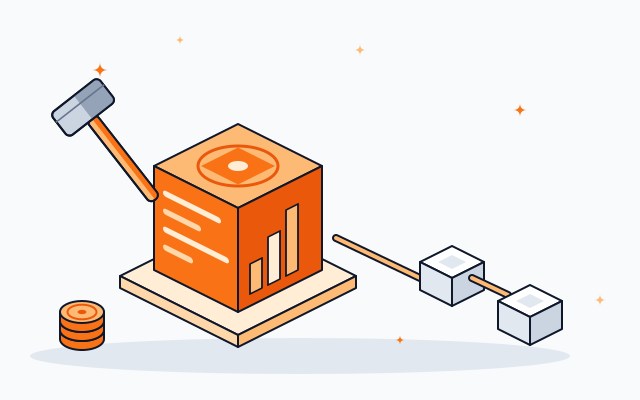
The settings live in the solana-genesis tool in the Agave source code. These are the ones that matter for a small chain:
| Setting | What it controls | Why you would change it |
|---|---|---|
| slots-per-epoch | How long an epoch lasts. Staking changes and rewards settle once per epoch. | Shorter epochs settle faster on a small chain |
| target-lamports-per-signature | The fee for each transaction signature | Cheaper or dearer transfers |
| fee-burn-percentage | The share of each fee that is destroyed | Control how fees affect supply |
| inflation | Whether stakers earn new coins: pico, full or none | Fixed supply or paid validators |
| bootstrap-validator-lamports | The balance of the first validator | Your launch stake |
| primordial-accounts-file | Accounts that exist from the first block | Your premine |
| faucet-lamports | Coins held by the faucet | Free test coins for users |
slots-per-epoch
- What it controls
- How long an epoch lasts. Staking changes and rewards settle once per epoch.
- Why you would change it
- Shorter epochs settle faster on a small chain
target-lamports-per-signature
- What it controls
- The fee for each transaction signature
- Why you would change it
- Cheaper or dearer transfers
fee-burn-percentage
- What it controls
- The share of each fee that is destroyed
- Why you would change it
- Control how fees affect supply
inflation
- What it controls
- Whether stakers earn new coins: pico, full or none
- Why you would change it
- Fixed supply or paid validators
bootstrap-validator-lamports
- What it controls
- The balance of the first validator
- Why you would change it
- Your launch stake
primordial-accounts-file
- What it controls
- Accounts that exist from the first block
- Why you would change it
- Your premine
faucet-lamports
- What it controls
- Coins held by the faucet
- Why you would change it
- Free test coins for users
The unit is the lamport: one coin is 1,000,000,000 lamports. Your total supply comes from the balances you create in genesis, so choose them once, before launch.
3Chapter 3
Validators: why at least three
The docs give no minimum. This is our advice, and the reasoning behind it.
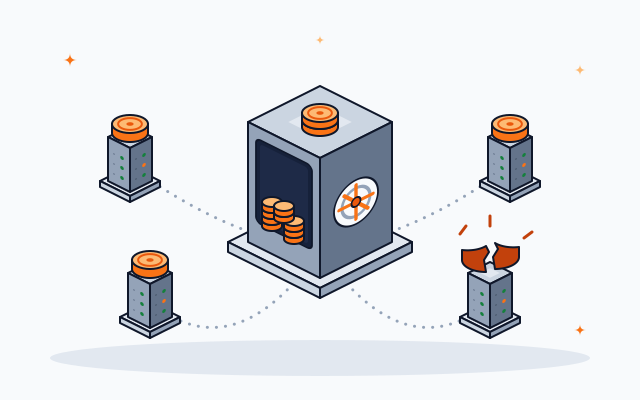
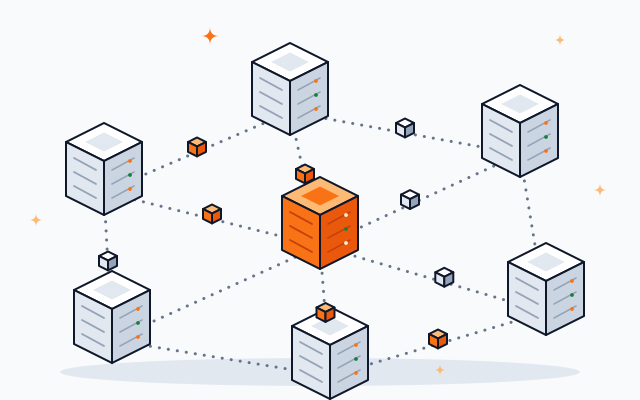
On Solana, validators take turns making blocks and vote on each other's work. The docs describe a transaction as confirmed once a supermajority of those votes arrive. The number of validators decides how many can stop before the votes fall short.
| Validators | After one stops | Verdict |
|---|---|---|
| 1 | No votes. The chain stops. | A test setup only |
| 2 | One validator left cannot gather a supermajority alone. The chain stops. | No real protection |
| 3 | Two validators remain, so votes can still be checked by more than one. The chain should keep going. | Our minimum |
1
- After one stops
- No votes. The chain stops.
- Verdict
- A test setup only
2
- After one stops
- One validator left cannot gather a supermajority alone. The chain stops.
- Verdict
- No real protection
3
- After one stops
- Two validators remain, so votes can still be checked by more than one. The chain should keep going.
- Verdict
- Our minimum
4Chapter 4
Hardware: the official specs are for mainnet
The numbers look huge. A new chain starts empty, but there is no official small-chain spec.
512 GB
The Anza requirements page lists a 2.8 GHz or faster CPU, three separate NVMe disks (accounts, ledger and snapshots, each 500 GB to 1 TB or more) and at least 2 Gbit/s of network for staked nodes. It never mentions private clusters, so every figure is mainnet-grade.
A new chain starts with an empty ledger and little traffic, so it can run on far less. The demo scripts in the docs run on a single laptop. But no one has published an official low-traffic spec, so any smaller number is an estimate. We size servers on the safe side, which is why Solana validators cost more than every other starting coin.
5Chapter 5
Explorer, faucet and wallets: the honest picture
A faucet and explorer exist. Wallet support is the part to check before you promise anything.
- WorksFaucetThe multi-node scripts include a faucet, so users can get free coins.
- WorksExplorerThe Solana Foundation explorer is open source under the MIT license and made for Solana clusters.
- UnconfirmedPointing the explorer at a custom chainWe could not confirm from the docs that the open-source explorer accepts a custom RPC address. We treat this as a limit until tested.
- UnconfirmedPopular walletsWe found no official statement that major wallets connect to a custom Solana cluster. Some may not. Check your wallet of choice before you promise it to users.
Tokens on your chain would follow the SPL token standard that Solana uses. If your community depends on one particular wallet app, test it against a running cluster first. This is the biggest practical risk of this base, and it is why we ask for a review before payment.
6Chapter 6
Mistakes that stop a first Solana chain
Five things that trip people up, and the check for each.
- Treating a token as a chainMost "create on Solana" guides make a token. A chain needs its own genesis and validators.
- Using master-branch options on an old releaseThe genesis options shift between releases. Read the settings for the exact release you run.
- Blocked UDP portsValidators need UDP ports 8000 to 10000 open between them.
- Promising wallet support earlyTest your users' wallet against a running cluster before you announce anything.
- Running one validatorIt is fine for a test. For a real chain, one server is one point of failure.
The software itself is not the barrier. Agave is open source under the Apache-2.0 license, and the docs describe a test validator that runs as a single node on a developer's workstation. The work is in choosing a release, holding it steady, and keeping several heavy servers healthy. That is the part we run for you.
Before you launch a Solana-based chain
0 of 5 done
7Chapter 7
What it costs with RocketRPC
A one-time core price, and a review before you pay.
The builder prices a Solana-based chain in the Premium tier. The core build is $399 one-time. The builder starts you at 3 validators and shows your exact total before you pay. Server prices are in the FAQ below.
There is no fee to any third party. Your chain is independent, so you do not pay anyone for a network seat. The ongoing cost is only the servers we run for you.
Questions people ask
Can I create my own blockchain on Solana?
Yes. Agave, the Solana validator software, is open source under the Apache-2.0 license. With your own genesis config it starts a separate cluster. It is a chain of your own, not a token on mainnet.
Is a Solana-based chain the same as a Solana token?
No. A token lives on Solana mainnet and uses its rules. A Solana-based chain has its own validators, fees, supply and genesis, and does not connect to mainnet.
Will my chain use SOL?
No. It has its own coin. The name and symbol are display details set in wallets and the explorer, not in the chain settings.
How many validators do I need?
The docs give no minimum. We recommend at least 3, so the chain keeps running if one validator stops. With one or two, losing a validator stops the chain.
Do I need the same servers as Solana mainnet?
The official specs are written for mainnet. A new, quiet chain can run on less, but no official smaller spec exists. Our builder sizes validators on the safe side.
Will Phantom or other wallets connect to my chain?
We cannot promise it. We found no official confirmation that major wallets accept a custom cluster, so test your wallet first.
Why do you review Solana chains before payment?
It is an early access base with the heaviest hardware. We check every chain before payment opens and email you within one business day.
What does it cost?
The core build is $399 one-time, and each validator server is $99 a month. The builder shows the full total before you pay.
Read next
Sources
- Agave validator repository, Apache-2.0 license
- Anza docs, clusters, genesis config and cluster independence
- Anza docs, multi-node cluster guide, setup, faucet, validators, UDP ports
- Agave genesis tool source, solana-genesis settings
- Anza docs, validator requirements
- Anza docs, solana-test-validator, a single-node development cluster
- Solana Foundation explorer, MIT license