Guide · Avalanche
How to create an Avalanche L1 (formerly subnet)
An Avalanche L1 is your own EVM blockchain with its own validators, coin and fees, that still plugs into Avalanche. Old subnet tutorials describe a model that has changed. This guide explains the new one, including the monthly AVAX fee that most guides skip.

By Arnold, DeFi writer
Updated · 9 min read
Before we start
Which one sounds like you?
What's inside
8 chapters. Read it start to finish, or jump to the part you need.
- Chapter 1What an L1 is now: subnets after ACP-77Subnets became L1s. Validators no longer need the big stake, but they pay a monthly fee.
 Chapter 2What you can customiseChain ID, fees, gas limit, premine and a set of on-chain controls. Block time is not on the list.
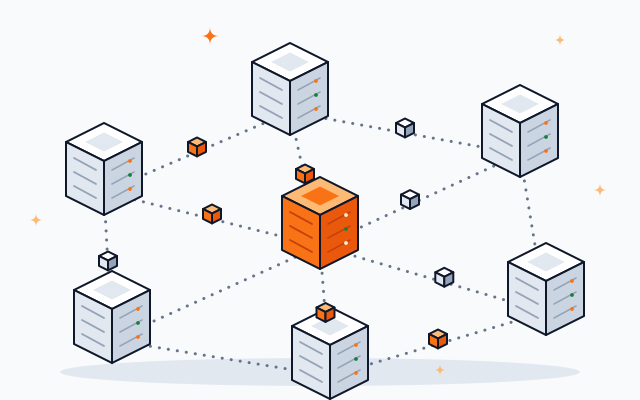 Chapter 3Validators and the Primary NetworkYour validators are yours, but they depend on Avalanche's P-Chain.
 Chapter 4The continuous AVAX feeAbout 1.33 AVAX a month per validator at the minimum rate, paid from a balance that must stay funded.
 Chapter 5Tooling in 2026: what movedAvalanche-CLI is in maintenance mode and Subnet-EVM now lives inside AvalancheGo.
 Chapter 6Who an Avalanche L1 is forGood fit: a game, app or business chain that wants EVM tools and its own fees.
 Chapter 7Common mistakesFour mistakes that cost time or money, and how to avoid them.
 Chapter 8What it costs with RocketRPCA one-time core price from us, plus the AVAX fee paid by you.
The short answer
The short answer
An Avalanche L1 is a blockchain you control that is secured by its own validators. You set a chain ID, a starting balance and fee rules in a genesis file, then run validators that also keep Avalanche's P-Chain in sync. Each validator pays a continuous fee in AVAX, about 1.33 AVAX a month at the minimum rate.
- Step 1: Write the genesisChain ID, fee settings and starting balances.
- Step 2: Choose validatorsYour own set, running your chain.
- Step 3: Register the L1On Avalanche's P-Chain, with a funded balance. With us, we do this for you.
- Step 4: Start the nodesThey sync the P-Chain and your chain.
- Step 5: Add explorer and faucetSo people can use it.
- Step 6: Keep the AVAX balance fundedOr validators go inactive.
That last step is the one that surprises people. Here is how it works.
1Chapter 1
What an L1 is now: subnets after ACP-77
Subnets became L1s. Validators no longer need the big stake, but they pay a monthly fee.
Avalanche used to call these chains subnets. A subnet validator also had to validate the main network, which meant staking 2,000 AVAX. A proposal called ACP-77 changed that. Its text says that "L1 validators are not required to validate the Primary Network".
| Feature | Old subnet | Avalanche L1 |
|---|---|---|
| Validate the main network | Required | Not required |
| Stake of 2,000 AVAX per validator | Required | Not required |
| Sync the P-Chain | Yes | Yes, always |
| Cost to run a validator | A locked stake | A continuous AVAX fee |
Validate the main network
- Old subnet
- Required
- Avalanche L1
- Not required
Stake of 2,000 AVAX per validator
- Old subnet
- Required
- Avalanche L1
- Not required
Sync the P-Chain
- Old subnet
- Yes
- Avalanche L1
- Yes, always
Cost to run a validator
- Old subnet
- A locked stake
- Avalanche L1
- A continuous AVAX fee
This matters if you are comparing chains. A Cosmos or Ethereum-style chain has no outside fee. An L1 trades that for a smaller starting cost and a ready link to the validator system of Avalanche.
The idea is simple: instead of locking a large stake, each validator pays a small ongoing fee. That lowers the cost of starting, and adds a monthly cost that never ends while the validator runs.
2Chapter 2
What you can customise
Chain ID, fees, gas limit, premine and a set of on-chain controls. Block time is not on the list.
An L1 usually runs the EVM, so wallets such as MetaMask can add it as a custom network. The Avalanche docs list these genesis settings:
| Setting | What it controls |
|---|---|
| chainId | The number wallets use to tell chains apart. Pick one no other chain uses. |
| gasLimit | How much work fits in one block |
| minBaseFee | The lowest price per unit of work |
| alloc | Starting balances, which is your premine |
| Precompiles | Built-in controls, such as one that changes the fee algorithm or one that mints the native coin |
chainId
- What it controls
- The number wallets use to tell chains apart. Pick one no other chain uses.
gasLimit
- What it controls
- How much work fits in one block
minBaseFee
- What it controls
- The lowest price per unit of work
alloc
- What it controls
- Starting balances, which is your premine
Precompiles
- What it controls
- Built-in controls, such as one that changes the fee algorithm or one that mints the native coin
The coin symbol is not a genesis setting either. It appears in wallets and explorer settings. Tokens on your L1 follow the usual EVM standards, such as ERC-20.
3Chapter 3
Validators and the Primary Network
Your validators are yours, but they depend on Avalanche's P-Chain.
The Avalanche docs say: "Every validator of an Avalanche L1 must sync the P-Chain of the Primary Network." The list of your validators lives on that P-Chain. So an L1 is secured by its own validators, but it is not separate from Avalanche the way a forked Bitcoin is separate from Bitcoin.
- YoursYour validatorsYou choose who runs them and how many.
- AvalancheThe P-ChainIt holds your validator list and your fee balance. Your validators must keep it in sync.
The docs name no minimum number of validators. We start every L1 at 3, so one validator can restart without stopping the chain. That is our own advice. Hardware is modest: the docs list 2 cores, 4 GB of RAM and 100 GB of storage for a low-traffic L1 (under 10 transactions per second), and 4 cores, 8 GB and 500 GB for a medium one. Syncing only the P-Chain needs a setting, otherwise Primary Network requirements are added on top.
4Chapter 4
The continuous AVAX fee
About 1.33 AVAX a month per validator at the minimum rate, paid from a balance that must stay funded.
~1.33 AVAX
ACP-77 says that active L1 validators pay "a continuous fee denominated in AVAX". The minimum rate is 512 nAVAX per second, which the proposal says equals about 1.33 AVAX a month. That holds while the number of fee-paying L1 validators stays at or below the target, and the rate rises when more validators are active.
| Validators | AVAX per month (minimum rate) |
|---|---|
| 1 | 1.33 |
| 3 | 3.99 |
| 5 | 6.65 |
1
- AVAX per month (minimum rate)
- 1.33
3
- AVAX per month (minimum rate)
- 3.99
5
- AVAX per month (minimum rate)
- 6.65
Plan this like a bill, not a one-off cost. Decide who tops up the balance, how often someone checks it, and how much AVAX you keep in reserve for a price swing. The more validators you add for safety, the larger the monthly fee, so the number of validators is a cost choice as well as a safety choice.
5Chapter 5
Tooling in 2026: what moved
Avalanche-CLI is in maintenance mode and Subnet-EVM now lives inside AvalancheGo.
Many tutorials still use older tools. Three changes matter:
- AvalancheGoThe node softwareIt is open source under the BSD-3-Clause license.
- MovedSubnet-EVMThe old repository is archived and says not to depend on it. The code moved into AvalancheGo.
- MaintenanceAvalanche-CLIThe repository says it is in maintenance mode, as of December 2025, with security patches only.
For services, the Avalanche docs describe add-ons that deploy a Blockscout explorer and a faucet. Blockscout uses its own software licence, so read its terms before hosting it commercially. A step-by-step tutorial that tells you to install the old CLI is probably out of date.
6Chapter 6
Who an Avalanche L1 is for
Good fit: a game, app or business chain that wants EVM tools and its own fees.
An L1 suits teams that want the EVM ecosystem but also want to control their own rules. Typical examples:
- GameA game currencySet a low minimum fee so small in-game transfers cost little, and control the starting balances.
- BusinessA private business chainRun validators you choose for points, tracking or settlement.
- AppAn app chainKeep your app's traffic on its own chain, with your own gas limit.
It is a poor fit if you need a fully independent network, or if a monthly fee paid in AVAX would be a problem. In that case a chain from another family, such as an Ethereum or BNB Chain style network, has no outside fee. The guide to creating a cryptocurrency compares the options.
7Chapter 7
Common mistakes
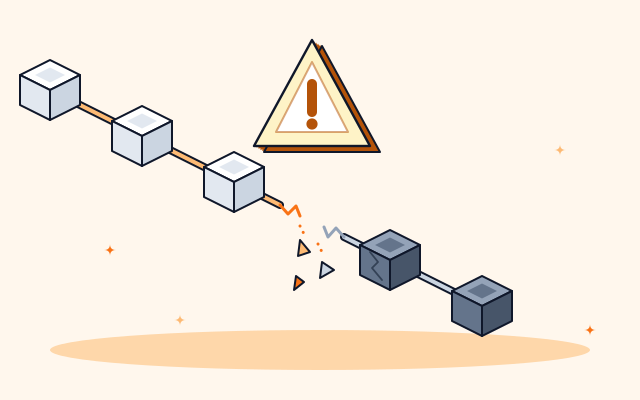
Four mistakes that cost time or money, and how to avoid them.
- Reusing a chain IDThe docs warn that a clash with another chain can cause issues. Pick a number that no other chain uses.
- Letting the fee balance run outThe validator becomes inactive. Check the balance on a schedule.
- Following an old subnet tutorialMany assume a 2,000 AVAX stake or the old CLI. Both are outdated for L1s.
- Expecting a block time settingSince the Granite upgrade, the target block rate no longer controls block production.
Before you launch an Avalanche L1
0 of 5 done
8Chapter 8
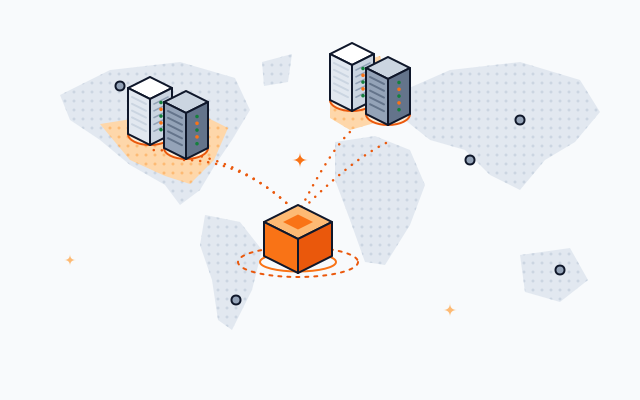
What it costs with RocketRPC
A one-time core price from us, plus the AVAX fee paid by you.
Our builder prices an Avalanche L1 in the Standard tier: $149 one-time for the core build. It starts at 3 validators, and you see the full price in the builder before you pay. Explorer, faucet and wallets are optional add-ons, with prices shown before you pay.
On top of that, there is Avalanche's validator fee in AVAX. For 3 validators that is about 3.99 AVAX a month at the minimum rate. During setup we tell you how much AVAX to send, we register your L1 on Avalanche and fund the validators with it, and you top the balance up. We cannot fix its dollar value, because AVAX moves in price. The builder tells you about this fee before you pay.
Questions people ask
What is an Avalanche L1?
A blockchain with its own validators, rules and coin that is registered on Avalanche. It is the new name for a subnet after ACP-77.
What happened to subnets?
Subnets became L1s. ACP-77 says L1 validators do not need to validate the Primary Network, so they skip the 2,000 AVAX stake. They pay a continuous fee in AVAX instead.
Is an L1 independent from Avalanche?
Not fully. Every L1 validator must sync the P-Chain of the Primary Network, and the validator list lives there.
How much does an L1 validator cost per month?
About 1.33 AVAX at the minimum rate, per validator, according to ACP-77. The rate can rise when more validators are active.
Can I choose my own block time?
Not as a simple setting. The docs say that since the Granite upgrade the target block rate no longer controls how fast blocks are produced.
Can I use MetaMask with my L1?
An L1 usually runs the EVM, so it can be added as a custom network using its chain ID and RPC address.
Is Avalanche-CLI still the way to go?
Its repository says it is in maintenance mode, with security patches only. Newer deployment tooling is described in the Avalanche docs.
What do I pay RocketRPC?
$149 one-time for the core build and $9 a month per server. The Avalanche fee is paid by you in AVAX.
Read next
Sources
- ACP-77, Reinventing subnets, validators, continuous fee and 512 nAVAX/s
- Avalanche docs, L1s, P-Chain sync requirement
- Avalanche docs, customise an L1, genesis settings and Granite note
- Avalanche docs, system requirements
- Avalanche docs, avalanche-deploy add-ons, Blockscout and faucet
- AvalancheGo repository, BSD-3-Clause
- Subnet-EVM repository, archived; moved to AvalancheGo
- Avalanche-CLI repository, maintenance mode
- Blockscout repository